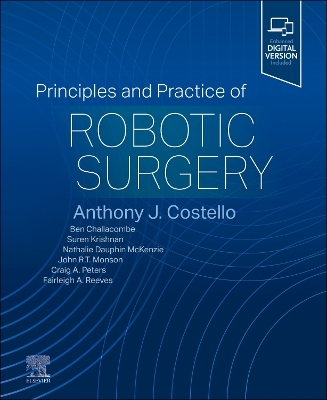
Principles and Practice of Robotic Surgery
 -10%
portes grátis
-10%
portes grátis
Principles and Practice of Robotic Surgery
Costello, Tony
Elsevier - Health Sciences Division
09/2023
688
Dura
Inglês
9780323798204
15 a 20 dias
Descrição não disponível.
?General principles
Anesthesia for robotic surgery
Physiology of pneumoperitoneum
Complications
Air embolism
Arrest. etc
Preoperative assessment and patient selection
Patient positioning and prevention of injury
Bedside - including port placement and docking
Draping robot
(basic understanding in order to be able to deal with trouble shooting)
Need all 4 arms to be draped even if not using
Port placement
Establishing pneumoperitoneum
Hasson
Veress
Optical
Insufflation pressure
Complications and trouble shooting
Eg. Adhesions, Obesity, Narrow pelvis, Prior surgery or radiotherapy, Existing stoma
Docking the robot
Modelled on Device teaching
Targeting
Ensuring adequate space between arms
Burping
Safety
e.g. height limitation
Locking instruments to avoid drift
Emergency undocking
Trouble shooting errors and faults
Instruments
Familiarity with commonly used laparoscopic instruments for the bedside assistant
Inserting and exchanging instruments
Diathermy settings
Console
How does it all work?
Basic rundown of buttons etc
Controlling the camera
Use of different lenses and changing view
Understanding when/why to use different lens
Swapping between instruments
Fourth arm control
Clutching
Customising your setup
Ergonomics
Scaling ratio movement
Adjusts movement speed to surgeon preference
Default 3:1, 2:1, 1.5:1
Available instruments
Diathermy settings
Anesthesia for robotic surgery
Physiology of pneumoperitoneum
Complications
Air embolism
Arrest. etc
Preoperative assessment and patient selection
Patient positioning and prevention of injury
Bedside - including port placement and docking
Draping robot
(basic understanding in order to be able to deal with trouble shooting)
Need all 4 arms to be draped even if not using
Port placement
Establishing pneumoperitoneum
Hasson
Veress
Optical
Insufflation pressure
Complications and trouble shooting
Eg. Adhesions, Obesity, Narrow pelvis, Prior surgery or radiotherapy, Existing stoma
Docking the robot
Modelled on Device teaching
Targeting
Ensuring adequate space between arms
Burping
Safety
e.g. height limitation
Locking instruments to avoid drift
Emergency undocking
Trouble shooting errors and faults
Instruments
Familiarity with commonly used laparoscopic instruments for the bedside assistant
Inserting and exchanging instruments
Diathermy settings
Console
How does it all work?
Basic rundown of buttons etc
Controlling the camera
Use of different lenses and changing view
Understanding when/why to use different lens
Swapping between instruments
Fourth arm control
Clutching
Customising your setup
Ergonomics
Scaling ratio movement
Adjusts movement speed to surgeon preference
Default 3:1, 2:1, 1.5:1
Available instruments
Diathermy settings
Este título pertence ao(s) assunto(s) indicados(s). Para ver outros títulos clique no assunto desejado.
surgery; robotic surgery; surgical simulation; Adaptive Learning; Aviation Education Human Factors Simulation; Surgical Anatomy Robotic surgery; Surgical simulation; E learning robotic surgery; simulation; safety; 3D generated hydrogel organ models for surgical practice; Video surgical anatomy as applied to robotic surgery; robotic procedures; cardiology; gastroenterology; interventional radiology
?General principles
Anesthesia for robotic surgery
Physiology of pneumoperitoneum
Complications
Air embolism
Arrest. etc
Preoperative assessment and patient selection
Patient positioning and prevention of injury
Bedside - including port placement and docking
Draping robot
(basic understanding in order to be able to deal with trouble shooting)
Need all 4 arms to be draped even if not using
Port placement
Establishing pneumoperitoneum
Hasson
Veress
Optical
Insufflation pressure
Complications and trouble shooting
Eg. Adhesions, Obesity, Narrow pelvis, Prior surgery or radiotherapy, Existing stoma
Docking the robot
Modelled on Device teaching
Targeting
Ensuring adequate space between arms
Burping
Safety
e.g. height limitation
Locking instruments to avoid drift
Emergency undocking
Trouble shooting errors and faults
Instruments
Familiarity with commonly used laparoscopic instruments for the bedside assistant
Inserting and exchanging instruments
Diathermy settings
Console
How does it all work?
Basic rundown of buttons etc
Controlling the camera
Use of different lenses and changing view
Understanding when/why to use different lens
Swapping between instruments
Fourth arm control
Clutching
Customising your setup
Ergonomics
Scaling ratio movement
Adjusts movement speed to surgeon preference
Default 3:1, 2:1, 1.5:1
Available instruments
Diathermy settings
Anesthesia for robotic surgery
Physiology of pneumoperitoneum
Complications
Air embolism
Arrest. etc
Preoperative assessment and patient selection
Patient positioning and prevention of injury
Bedside - including port placement and docking
Draping robot
(basic understanding in order to be able to deal with trouble shooting)
Need all 4 arms to be draped even if not using
Port placement
Establishing pneumoperitoneum
Hasson
Veress
Optical
Insufflation pressure
Complications and trouble shooting
Eg. Adhesions, Obesity, Narrow pelvis, Prior surgery or radiotherapy, Existing stoma
Docking the robot
Modelled on Device teaching
Targeting
Ensuring adequate space between arms
Burping
Safety
e.g. height limitation
Locking instruments to avoid drift
Emergency undocking
Trouble shooting errors and faults
Instruments
Familiarity with commonly used laparoscopic instruments for the bedside assistant
Inserting and exchanging instruments
Diathermy settings
Console
How does it all work?
Basic rundown of buttons etc
Controlling the camera
Use of different lenses and changing view
Understanding when/why to use different lens
Swapping between instruments
Fourth arm control
Clutching
Customising your setup
Ergonomics
Scaling ratio movement
Adjusts movement speed to surgeon preference
Default 3:1, 2:1, 1.5:1
Available instruments
Diathermy settings
Este título pertence ao(s) assunto(s) indicados(s). Para ver outros títulos clique no assunto desejado.
surgery; robotic surgery; surgical simulation; Adaptive Learning; Aviation Education Human Factors Simulation; Surgical Anatomy Robotic surgery; Surgical simulation; E learning robotic surgery; simulation; safety; 3D generated hydrogel organ models for surgical practice; Video surgical anatomy as applied to robotic surgery; robotic procedures; cardiology; gastroenterology; interventional radiology